
Levy 72-Hour Release Window
Sheriff Bobby McCallum’s official Levy County JailTracker offers Current Only, All, and Released modes. Its Released mode provides seven-day and 30-day choices. There is no separate rolling 72-hour option. To form a three-day view, select seven days and review the final release dates that overlap the desired interval.
A three-day range crosses more calendar boundaries than a same-day check. That makes the seven-day starting set useful, but it also makes the missing time of day important. JailTracker’s grid shows a calendar date without an exact release time. A result on the first date may fall before the 72-hour cutoff, while one on the last date can fall inside it. The Detention Bureau’s movement record resolves that uncertainty.
Check Levy 72-Hour Releases
Set the interval before opening the public list. Write down the current date and time, then count back 72 hours. This prevents the phrase “last three days” from silently becoming three whole calendar days, which can be longer or shorter than the requested rolling span.
- Open JailTracker and choose Released as the search type.
- Select the seven-day range, the shortest official Levy release window.
- Review each of the calendar dates crossed by the exact 72-hour interval.
- Open likely matches and compare names, original booking dates, identifiers, and images when present.
- For results on either boundary date, call 352-486-5121 and request the exact final release time.
- Ask whether each event was release to the community or transfer to another authority.
The All mode can help when a known name falls outside the preset display. It does not turn JailTracker into a guaranteed archive. If the goal is only today’s entries, the Levy County 24-Hour Release List uses a tighter date comparison. Older local history belongs in a booking or movement request and the court file.
Note: Save the relevant booking identifier before the convenient released view changes, since that key makes a later records request more precise.
Levy 72-Hour Release Fields
The Levy grid carries enough information to match a person to a booking episode, but not enough to explain the whole event. Fields can vary by agency configuration. Release reason was not exposed in the interface reviewed, and no update schedule was promised. Use the table to separate what the public row can show from what still needs an agency record.
| Displayed or supported field | How to read it |
|---|---|
| First, middle, and last name | Use with another identifier because people may share a name. |
| Original book date | Connects the result to the relevant Levy County custody episode. |
| Final release date | Shows the recorded calendar day, not a precise 72-hour boundary. |
| Booking, jacket, or facility field | May provide a record key or agency context when configured. |
| Offender image | Can aid identity matching but does not prove present custody or case outcome. |
| Charge, case, bond, or hold detail | May appear in detail; consult the court and agency record for meaning. |
An LCSO release or movement record can add the timestamp, release event code, destination, receiving agency, and holds. Those fields matter most at the first and last edges of the interval. A court order may then explain the legal action, while the Sheriff’s record establishes what physically happened to the booking.
Levy Weekend Release Review
The 72-hour approach is most helpful after a weekend, holiday, or delayed check. Several calendar dates stay visible in one review, so a release that was absent during an earlier visit may be found later. Still, the research found no published statement that JailTracker updates on a fixed hourly or real-time cycle. Appearance in the grid and the custody event itself may not occur at the same moment.
Do not assume that a weekend date proves the person left through the public exit or returned home. Processing can include transport to FDC, another county, federal custody, or ICE. Receiving systems may also lag during an overnight movement. Ask LCSO for the exact event and destination, then use the receiving system when the answer includes a transfer.
Holidays also affect practical follow-up. The Detention Bureau phone is the direct route for a current status question, while a written request produces a record for later use. A public-record response takes a reasonable period for retrieval, review, and lawful redaction; no fixed Levy turnaround was published. Set the three-day interval precisely so staff can locate the maintained data efficiently.
Request Levy 72-Hour Release Data
Use the LCSO NextRequest portal when the date-only list cannot answer the question. For an aggregate, request an existing release-event report, log, or vendor export for an exact start and end timestamp. Suggested fields are the person’s name, booking number, booking time, final release time, event type, destination or receiving agency, and public hold information.
Florida Chapter 119 gives access to public records subject to exemptions, but it does not always require an agency to create a new analytical document. If no custom 72-hour report exists, ask for the release-event log in the form maintained. Narrow dates and defined fields can reduce retrieval work. Accept lawful redaction of protected information, and ask for the cited exemption if a field is withheld.
The Sheriff’s public-record request instructions explain that the requester can describe the information even without knowing a formal record title. They also caution against entering sensitive personal information in a public submission. A public booking number and a narrow date range are safer, stronger identifiers than unnecessary private data.
The manifest’s official portal source shows the request and prior-response interface.
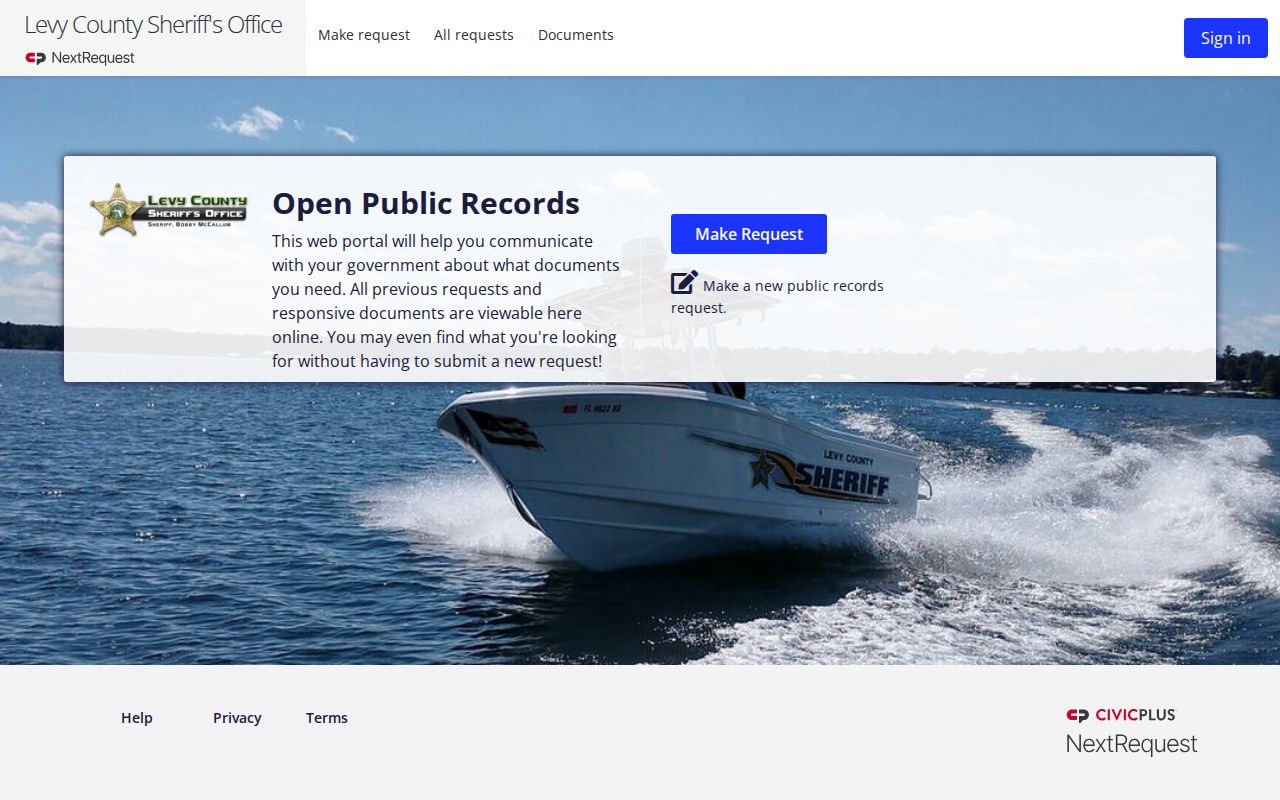
This view is the formal fallback when a rolling-hour list is not maintained as a public filter.
Trace Levy Release Destinations
A final release date confirms that the LCSO booking ended. It does not, by itself, confirm release from all custody. County and state systems answer different questions. The Florida Department of Corrections released search covers people sentenced to state prison or included in state supervision data, not every person who served a county-jail-only term.
| Possible outcome | Verification route |
|---|---|
| Community release from Levy jail | LCSO event with time, release type, and no receiving agency or unresolved hold. |
| Transfer into state custody | FDC offender record by name or six-character DC number. |
| Federal custody | BOP locator for a sentenced federal person, plus the federal docket when needed. |
| Immigration transfer | ICE locator and ERO confirmation; “released to ICE” is not freedom from custody. |
| Continuing supervision | FDC supervised-offender record or the governing court and agency documents. |
VINELink can provide custody-change notice for a participating county or state record, but it relays the reporting agency’s feed. A transfer alert, stale result, or missed notice should be checked with the custodian. The broader Levy County release verification path explains how court and agency records corroborate a named person’s outcome.
Note: A released row, current-roster disappearance, or booking image alone cannot distinguish community return from transfer to another authority.
Levy 72-Hour Data Quirks
The local seven-day filter is a practical convenience, not a 72-hour product. Users must make the three-day subset themselves, and the date-only grid leaves part of each edge unresolved. This distinctive limitation should remain visible whenever a Levy three-day release claim is made. Giving the result a “72-hour list” label does not add precision that the source lacks.
Nor do the seven-day and 30-day settings state the legal retention period. All mode is broader, yet the Sheriff and vendor publish no guarantee that it preserves every old booking indefinitely. For durable history, request LCSO’s existing booking and movement records. Use the Levy Clerk for filed bond, dismissal, judgment, sentence, and release orders, remembering that the court’s legal action and the jail’s physical event are related but not identical.
No official Levy Sheriff inmate-release mobile app was verified during the July 2026 research. Sheriff social posts and press releases are selective news channels, not a systematic three-day log. The official JailTracker, records custodian, and receiving-agency check remain the sound route.
Names should be tested with care across a multi-day list. A prior surname, hyphenated form, suffix, or alias can affect a result, but only use variants offered by the official system. Compare the original book date and public identifier before deciding that two similar rows concern the same person. When no match appears, absence can reflect timing, spelling, a transfer, or the limits of the chosen display rather than proof that no Levy County release occurred.
For later review, preserve the exact interval, the date and time of the search, the public result URL, and the booking identifier. Then request the Sheriff’s maintained event if the public row changes. This creates a traceable sequence without treating a temporary web display as the underlying government record.