
Levy Parole and Probation Compared
Florida uses several forms of supervision in the community. Probation is a court-ordered sentence or part of a sentence. A person may start probation without first serving a state-prison term. Parole is a conditional release decision for a prisoner who is legally eligible for that older and narrower system. The Florida Department of Corrections Community Corrections staff supervise probation, community control, and several post-prison release groups. The Florida Commission on Offender Review makes parole and certain conditional-release decisions.
The exact label matters. Florida largely ended parole for offenses committed on or after October 1, 1983, though chapter 947 preserves specified exceptions and older cases. Many modern prison departures therefore involve sentence expiration with gain-time, conditional release, or another statutory process, not parole. A Levy County court can also order probation in a county case. The Levy Clerk criminal file can show that court order. FDC says its database covers state supervision, while county probation not run by FDC is outside that database.
| Feature | Parole | Probation |
|---|---|---|
| Source | FCOR decision for an eligible prison case | Court sentence or order |
| Custody before supervision | Follows prison custody | May begin without a state-prison term |
| Daily supervision | FDC Community Corrections | FDC or the agency named by the court |
| Best proof | FCOR order plus current FDC record | Judgment and current supervision record |
Check Levy County Supervision Status
The FDC offender-search menu separates active inmates, released inmates, supervised people, and absconders. Search by the six-character DC number when it is known. A name search can work, but the match should be checked against age, aliases, offense county, case rows, and other public identifiers. A person in the supervised population has generally left prison or jail for the community unless another current custody record says otherwise.
Use the public result as a locator, then preserve the exact terms. “Supervised” is not a generic word to replace the actual supervision type. “Absconder” means FDC reports a loss of contact or noncompliance. It does not prove the person has been arrested on a warrant. A status of released or supervision terminated describes a past state relationship and should be read beside the start and end dates.
- Open the FDC menu and select the supervised-offender search or absconder search that fits the question.
- Enter the DC number, or search the name and compare the full public identity fields before choosing a record.
- Record the supervision type, current status, circuit or office, dates, and Levy County case or offense row exactly as shown.
- Confirm the reporting office against the release paperwork or FDC. An old address in a directory is not enough.
- For parole, compare the FDC record with the actual FCOR order. A hearing date or agenda entry alone does not grant release.
Levy Supervision Through Circuit Eight
Levy County belongs to FDC Community Corrections Circuit 8, which also serves Alachua, Baker, Bradford, Gilchrist, and Union counties. The official circuit page lists Circuit Office 085 in Alachua and nearby Office 081 in Trenton. Yet that page does not assign every Levy address to Trenton. A person should follow the office and reporting terms on current release papers, while anyone checking a public record should confirm the live assignment with FDC.
The official Circuit 8 directory shows the local office layer. It is the right place to check current office contacts, not proof of where one particular person must report. Sheriff Bobby McCallum’s LCSO cannot set or verify FDC reporting instructions. A Levy Clerk file may contain the probation order, but it may not reflect later operational changes in office assignment.
FDC Office 081
1122 East Wade Street, Suite B
Trenton, FL 32693
352-493-6760
Confirm the assigned office before a visit.
The manifest image below comes from the FDC Circuit 8 office page.
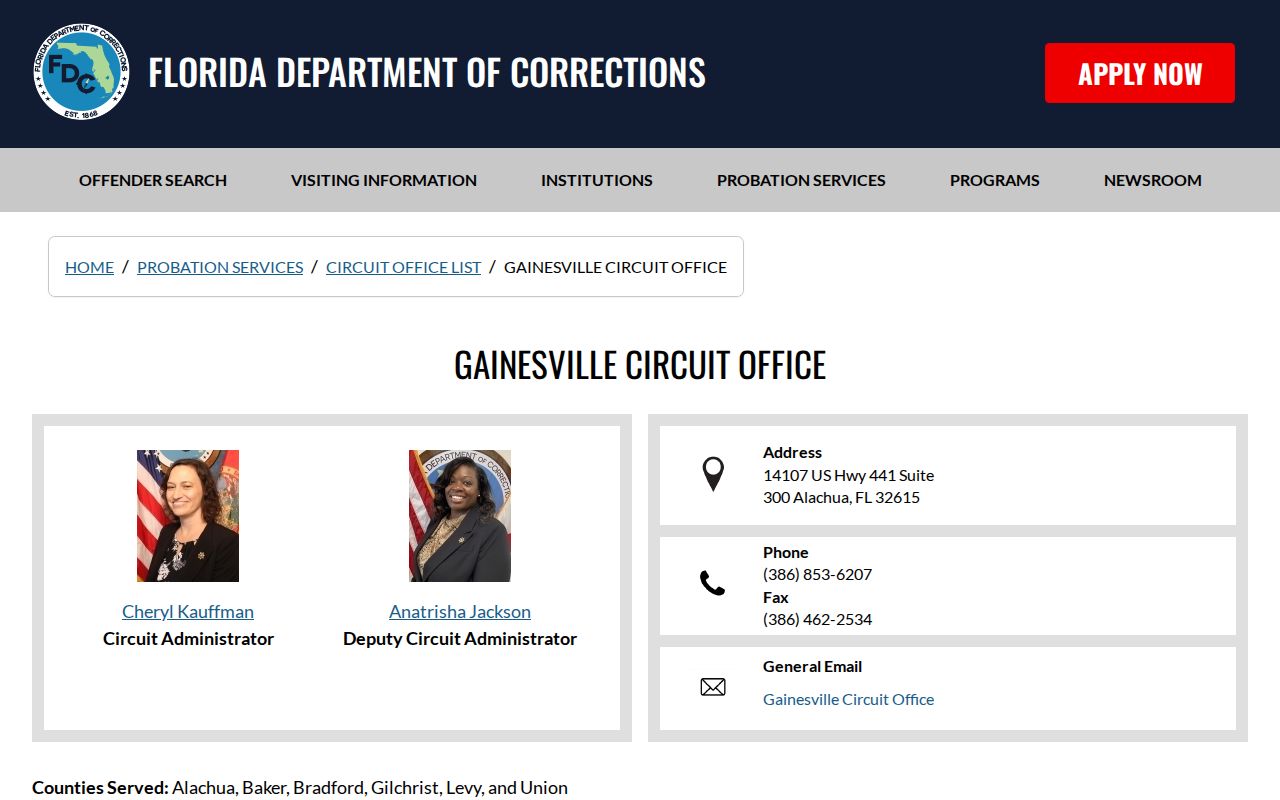
Its Trenton listing is a useful contact point, while the live offender record or FDC confirmation controls the actual office assignment.
Levy Parole Hearing Records
The FCOR voting schedule provides dates and links to detailed parole case lists. It is a calendar, not a final-decision database. A scheduled vote does not mean parole was granted. For a Levy County case, match the name and DC number, note the agenda date, then obtain the final vote sheet or order when the outcome matters. Current dates and meeting methods can change.
Parole terminology can also prevent a bad conclusion. A presumptive parole release date, often called a PPRD, is a tentative guideline date. An effective parole release date is the date later set after the Commission considers institutional conduct and an acceptable plan. Review can retain, reduce, extend, suspend, or replace an earlier date. Request a PPRD or EPRD order, revocation order, final vote sheet, or disposition from FCOR public records, then compare it with FDC’s released and supervised searches.
Section 947.16 sets interview timing for the limited group that remains eligible for parole. It does not make every Florida prisoner eligible. The safe question is not “When is the parole hearing?” but “What release mechanism and order apply to this DC number?”
Note: An FCOR agenda identifies planned action, while the Commission order and FDC status establish what happened after the vote.
Levy Probation Violations and Absconders
Conditions vary with the court judgment, release order, and type of supervision. Common duties can include reporting, approved travel limits, payment terms, treatment, or other case-specific rules, but no generic list can replace the signed order. A public FDC record may show supervision status and office data. It does not reproduce every condition. The individual should rely on official paperwork and the assigned officer for instructions.
An absconder is a person whom the supervising agency reports as no longer maintaining required contact. It is an agency status, not a new conviction. Search FDC’s absconder dataset and read any warrant or violation indicator with care. The status does not show whether an arrest has already occurred. A later jail booking, court docket entry, or FDC update may be needed to trace the event sequence.
VINELink can provide custody-change notices for a participating jail or prison, but it does not monitor every probation event. Florida’s separate FDC notification process covers listed movements such as release, transfer, escape, death, and out-to-court. Neither source should be described as a complete probation-violation alert. For a current Levy custody question, use the LCSO Detention Bureau record.
- Community control
- A more restrictive form of supervision in the community.
- Absconder
- A person the agency reports has lost contact or failed to comply with reporting.
- Violation
- An alleged breach of a supervision term, subject to agency and court process.
- Discharge
- The formal end of the supervision term or authority.
Records After Levy County Release
A former Levy detainee has a distinct personal-record option after leaving the jail. The LCSO Smart Jail Mail instructions say the former inmate can use the inmate number and password to download photos, messages, and scanned postal mail processed during confinement at no charge. Request, grievance, and medical forms are not available through that route.
Smart Jail Mail is not a supervision lookup. It also is not public access to another person’s mail or booking photo. Its role is narrow but useful: the released account holder can recover certain personal material after the jail account changes. LCSO did not publish a matching physical-property procedure in the sources reviewed, so property pickup terms should be confirmed with the Detention Bureau instead of inferred from the mail rule.
Note: Smart Jail Mail serves the former account holder and does not prove parole, probation, a supervision office, or final discharge.
Confirm Levy Supervision Discharge
Supervision ends through the governing order, sentence, statute, or agency action. The public FDC detail may display a past end date or a terminated status. For parole and Commission-run programs, an FCOR order may be the key record. For probation, the Levy court file can show the sentence and a later termination order. None of those should be replaced with an estimate based only on the original term.
Florida public-record law allows access to agency records subject to exemptions. Protected victim, medical, juvenile, investigative, or sealed information may be withheld or redacted. Ask for the releasable termination or discharge record by name, DC number, case, and approximate date. If the web status conflicts with release papers, send the exact field and supporting order to the agency that maintains the record.
A person can be out of prison yet still under supervision. A person can also finish supervision while a court file remains available. The Levy County released inmate search and records path explains how to pair the county custody event with state and court sources. The best final check uses both the current FDC status and the document that ended supervision.