
Levy Released Mugshots Need Context
A booking photograph links a person to one intake event at Sheriff Bobby McCallum’s Levy County Detention Bureau. It does not show whether a charge was filed, dismissed, reduced, or proved. The person may have left on bond, recognizance, time served, a court order, sentence completion, or transfer. A picture cannot distinguish those outcomes.
The custody date matters as much as the face. A photo may stay online after the related booking ends. Conversely, a person can be released even if no image appears in a public result. Match the name, booking or jacket number, book date, final release date, and case information before deciding which event the image belongs to. Then use the Levy Clerk file or release movement record for disposition and custody facts.
Where Levy Release Mugshots Appear
Levy County does not require one image source to hold every booking photo forever. The recent LCSO interface, the sheriff’s underlying booking record, FDC, and a narrow FDLE registry each serve different populations. News and third-party pages may preserve a copy, but they are leads rather than official custody records. No official Levy Sheriff inmate or release mobile app was verified in the 2026 research sweep.
| Channel | Has photo? | How to access |
|---|---|---|
| LCSO JailTracker Released search | May show offender image | Select Released, then 7 Days or 30 Days and open the matching detail |
| LCSO booking record | Authoritative county request path | Ask for the photograph tied to a booking number and date |
| FDC released-offender record | Often, when available | Search a state prisoner by DC number or name |
| FDLE registrant search | Can include a thumbnail | Use only for the legally defined registration population |
| News or agency social post | Selective | Use as context and verify the event from official records |
| Third-party category | May retain a stale copy | Treat as a lead only, with no proof of current custody |
Note: No photo source should be used alone to identify a person, determine a case outcome, or establish present custody.
Search Recent Levy Release Mugshots
The official Levy JailTracker offers Current Only, All, and Released search types. Released has 7-day and 30-day choices. It does not have a true 24-hour or 72-hour selector. The interface supports offender-image controls, but a photo is not guaranteed on every Levy result and vendor fields can change.
Use last, first, and middle name plus the original book date and final release date. Open the detail when available and compare the booking or jacket identifier, charge or case fields, and image. The visible final release date says that LCSO custody ended. It does not state whether the event was community release or transfer, and no update cadence or permanent retention period is promised.
- Select Released and begin with the 7 Days window for a recent Levy County booking.
- Search the full name and compare the displayed book and release dates.
- Open the detail and confirm the booking identifier before associating the photograph with the person.
- Use the release event or court record to determine what happened after the booking.
- If the result has aged out or has no image, request the booking photo from LCSO.
Current Only answers who is in the county jail now. A released person will usually disappear from that live roster. A recent image in Released mode belongs to the completed booking and should not be read as proof the person remains jailed.
Request a Levy Booking Photograph
The durable county route is the LCSO NextRequest portal. Florida public-record law does not require a requester to know the agency’s exact record title. Give a narrow description of the existing booking and image. Include full name, date of birth if known, approximate booking dates, and the booking or jacket number if the public result supplies it.
Ask for “the booking photograph associated with booking [number/date]” and the related releasable booking and release or movement event. Request the release date and time, event code or description, destination or receiving agency, and public hold information. That pairing gives the image its custody context. It also lets the custodian redact exempt fields without turning the request into a broad demand.
- Open NextRequest and choose the option to make a public-record request.
- Identify one person and booking with the best date range and number available.
- Name the booking photograph and the related release or movement record.
- Ask for electronic delivery and a cost notice before charges pass a chosen limit.
- If an item is missing, ask whether it does not exist, sits in another system, or was withheld under a cited exemption.
The Sheriff’s public-record instructions provide the source lead-in for the captured request page.
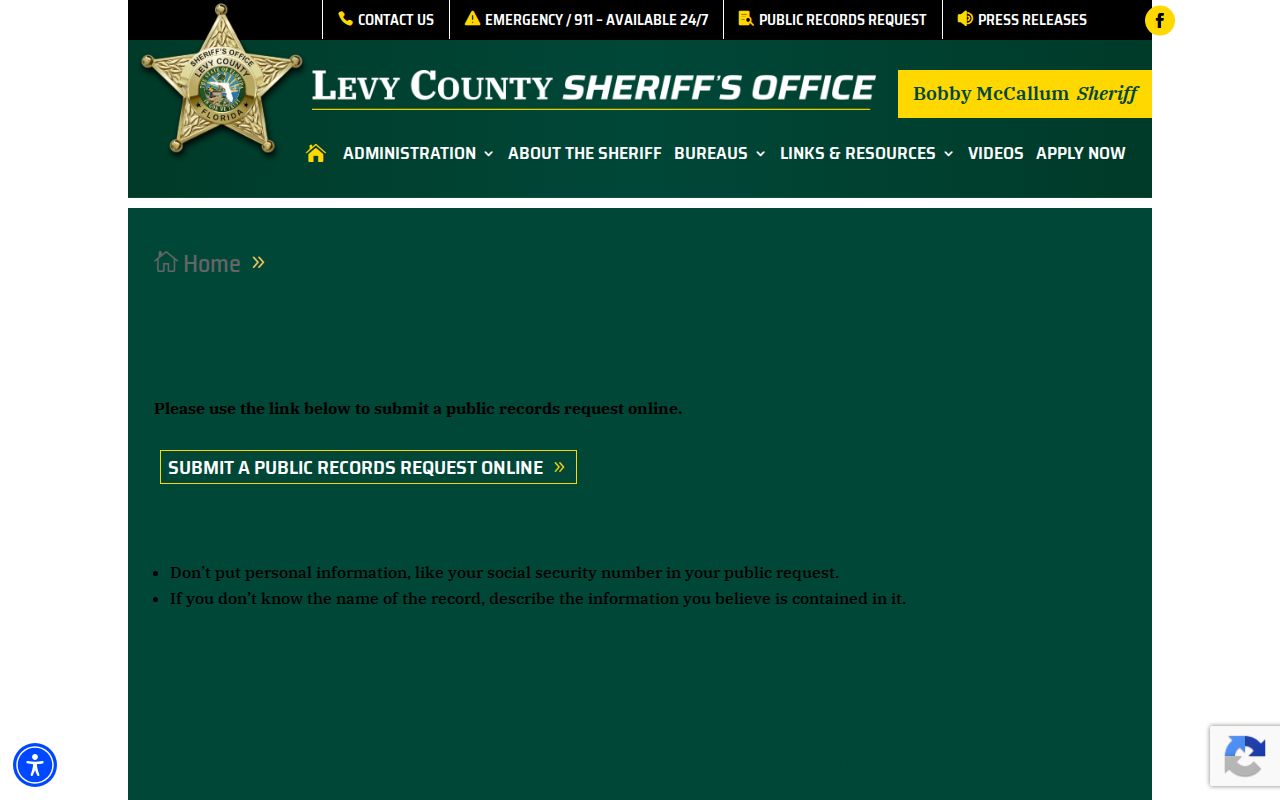
The instructions support a descriptive, booking-specific request and warn against putting sensitive personal data into a public submission.
Florida Photos After Levy Release
A person sentenced from Levy County to state prison moves into the statewide FDC system. The FDC released-inmate search accepts first name, last name, or a six-character DC number, can include aliases, and offers photo controls. A detail page may show an offender photograph. It is an FDC image, not necessarily the Levy arrest photo.
Match the DC number, identity fields, offense county, sentence rows, and release data. FDC says its records cover felony offenders sentenced to state prison or state supervision. It excludes people who served only a Levy county-jail sentence and county probation outside FDC. A missing FDC result therefore does not mean no county booking photo exists.
The successful project image comes from the official FDC released search.
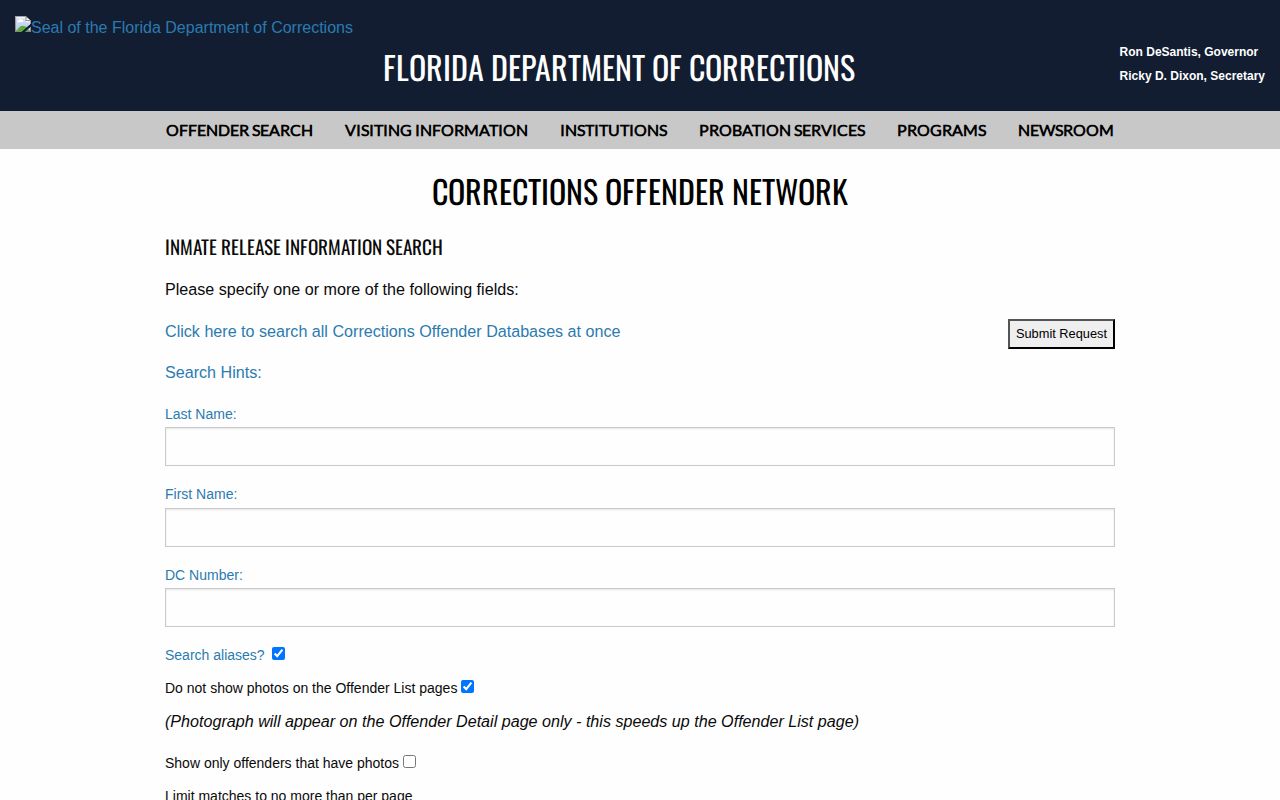
The photo controls shown there belong to Florida’s state-prison record, so the result must not be presented as the county jail’s original image.
The FDLE Sexual Offender and Predator Search is narrower. It can display thumbnails, aliases, and statuses such as Released - Subject to Registration or Supervised - FDC. Use it only for the population that has a legal registration duty. Name and photo alone are not definitive identity; FDLE notes that fingerprints provide definitive confirmation.
Levy Mugshots in Secondary Sources
LCSO press releases, the sheriff’s social channel, and local news outlets can preserve an arrest image after the live jail result changes. Coverage is selective. It may describe an accusation at the time of arrest and never add the later disposition or release. Check the publication date, identify the named agency, and pair the image with the Levy court or release record.
Third-party and aggregator pages form another discovery category. They can mirror old vendor data, keep a stale image, or attach a photo to an outdated custody label. No commercial link is needed to understand that risk. An old page is not evidence of current confinement, and a demand for payment is not the same as an official correction process.
Florida does not have a verified official Levy inmate-release mobile app. The Alert Levy app serves emergency and disaster preparedness, not inmate lookup. The FDLE app deals with statewide registries and wanted-person functions, not LCSO’s recent-release photos. These negative findings prevent a user from being sent to the wrong tool.
Does a news mugshot prove the person was convicted?
No. It documents what a publisher selected to show, often near the arrest date. The court disposition and custody record answer different questions.
Note: Always date-check a secondary image and return to the agency record tied to the same booking before drawing a custody conclusion.
Levy Mugshot Removal Rules
Florida Statutes section 901.43 creates a precise process for covered commercial booking-photo publishers. The photographed person or legal representative sends a written request by registered mail to the publisher’s registered agent. The request must provide enough proof of identity and specific information to identify the photo. A covered publisher must remove it without charge within ten calendar days after receipt.
The law also bars solicitation or acceptance of payment to remove covered images and restricts republication or redissemination in the defined circumstances. It provides court remedies and consequences for noncompliance. Yet subsection (5) limits the statute to entities that accept or seek removal payment or whose main business model is commercial booking-photo publication for gain. It is not a universal deletion command for every sheriff page or news archive.
Juvenile records have a separate nuance under section 985.04. Some felony-level juvenile arrest and photo information may not be confidential solely because of age, but the records custodian may choose not to publish the child’s booking photograph electronically. A requestable record is not always a photo that must appear on a website.
Sealing and expunction can also affect public access, but eligibility and scope depend on the court order and Florida law. A hidden photo does not prove an expunction, while an order does not guarantee that every noncovered news copy vanishes at once. Provide the order and identifiers to the agency or publisher that controls the displayed image.
Personal Photos Are Not Mugshots
LCSO’s Smart Jail Mail system has a different post-release photo path. A former detainee can use the inmate number and password to download personal photos, messages, and scanned postal mail processed during confinement at no charge. Those files belong to the former account holder’s communication record. They are not public government booking photographs.
Request, grievance, and medical forms are not available through that Smart Jail Mail path. No one seeking a public Levy booking image should be directed into another person’s account. Use JailTracker, the sheriff’s records custodian, FDC, or the limited FDLE registry instead. For a named-person release check tied to the image, the Levy County released inmate search supplies the agency-by-agency path, while the Levy 24-hour release method explains the limits of the county’s seven-day interface.