
Federal Release Records Scope
The Federal Bureau of Prisons confines people committed after federal conviction. Its public locator is national. A Levy County connection can come from an arrest, investigation, residence, or case event, but that does not make the Levy jail a historical source for the federal prison term. The facility map found no BOP institution in Levy County. A person can be placed in a federal facility elsewhere and later moved during the sentence.
The BOP Inmate Locator covers federal inmates from 1982 forward. It can show name, register number, age, race, sex, release date, and location. A past date with no institution, or a location or status that says Released or Not in BOP Custody, verifies departure from BOP custody. It does not necessarily mean freedom from state, local, or immigration custody. It also does not show whether a term of federal supervised release remains.
| BOP display | How to interpret it |
|---|---|
| Institution listed | The locator associates the person with current BOP custody at that site. |
| Future release date | A projection that may change. |
| Past date, no institution | Release from BOP custody on the displayed date. |
| Released or Not in BOP Custody | No current BOP custody, subject to other systems and supervision. |
Search Federal Release Records
BOP supports an identifier search and a name search. Use the BOP Register Number when known. The locator also accepts DCDC, FBI, or INS numbers. A name search uses first, middle, and last name with race, age, and sex filters. An identifier avoids many false matches, while the demographic fields help separate people with similar names.
- Open the national BOP locator and choose number or name search.
- Enter the complete identifier, or the most complete name with available filters.
- Match the register number and demographic fields before relying on the result.
- Read the Release Date and Location columns together.
- For a past release, compare the federal judgment or docket and check other custody when a transfer is possible.
The official BOP search interface shows the available number and name paths.
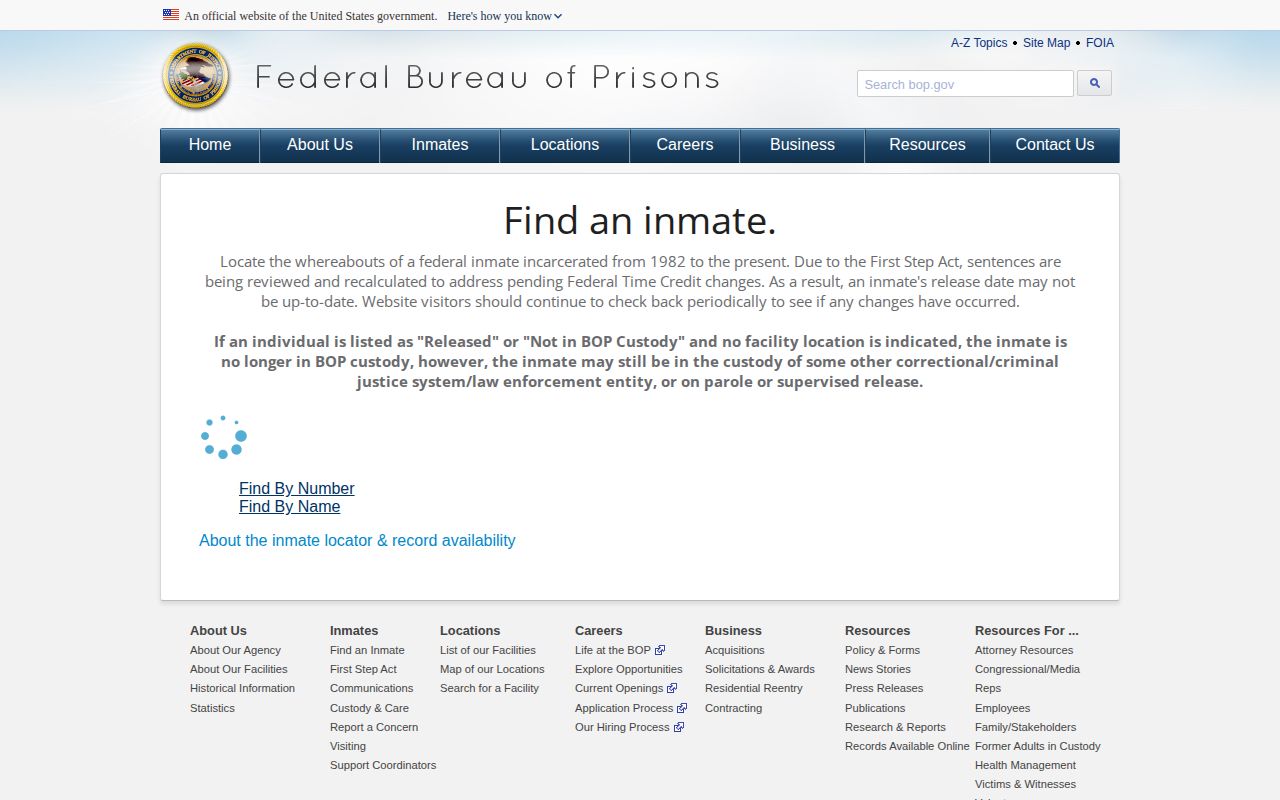
The search is the correct first source for a completed federal prison term. Levy JailTracker and the FDC offender search answer different custody systems and should not be used as substitutes.
Read Federal Release Status
The BOP locator field guide gives a specific rule for past dates and absent facilities.
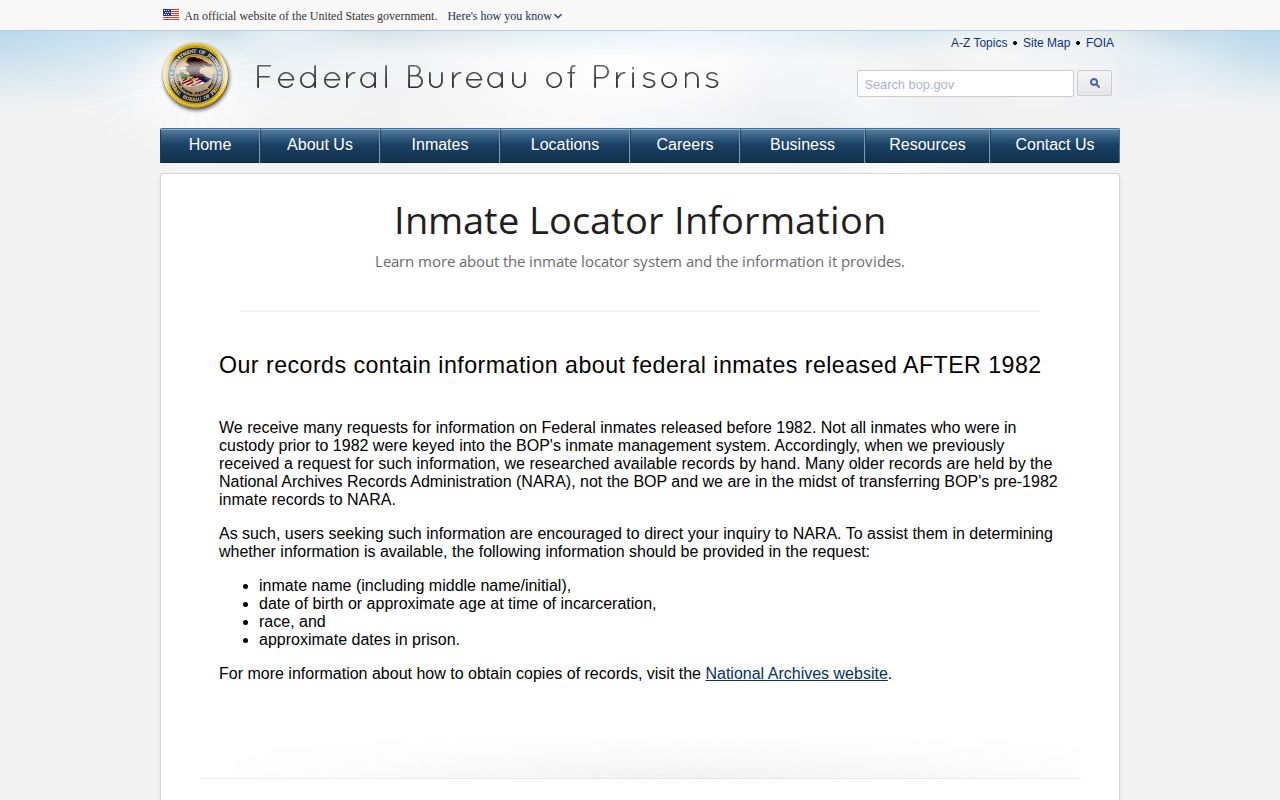
The field guide confirms that a past date with no facility means release from BOP custody. This is narrower than a finding that the person is free of every authority. A transfer to ICE, a state detainer, another sentence, or a federal court order can affect what happens next. The federal docket supplies the judgment and supervised-release term that the locator does not show.
- Register Number
- The BOP identifier used to distinguish federal records.
- Projected date
- A future administrative estimate that can change.
- Released
- No longer in BOP custody according to the locator.
- Supervised release
- A federal court-ordered community term after imprisonment, monitored through the federal system.
- Detainer
- Another authority’s basis to assume or continue custody.
Federal Projected Release Dates
A future BOP release date is projected. It may change after sentence-credit review, First Step Act recalculations, court action, disciplinary matters, or another update. The locator warns that public dates can be affected by these calculations. A future date should not be reported as a fixed exit time, travel plan, or guaranteed community release.
When a projected date is material, compare the BOP result with the federal judgment and later docket entries. The judgment states the prison and supervised-release terms. It may also show how counts run. BOP administers the sentence, while the sentencing court resolves legal changes through filed orders. If the date seems inconsistent, preserve the register number and displayed field and ask the proper federal record custodian rather than calculate a new date independently.
A past release date is stronger historical evidence. Still, it marks departure from BOP custody. It does not display the full reason, destination, or court-supervision conditions. A federal supervised-release term can begin after prison, and an immigration or state authority may receive physical custody at the gate.
Corroborate Federal Release Records
The federal criminal docket answers questions the locator cannot. It can identify the judgment, sentence, amended orders, revocation events, and term of supervised release. PACER or the sentencing federal district court is the usual court-record path. Use the person’s name and federal case number, and obtain the filed document when exact wording matters. The docket should not be treated as a live custody locator, just as the locator should not be treated as the full case history.
If the sequence begins at the Levy County jail, the Sheriff’s Office led by Sheriff Bobby McCallum supplies the county movement record. FDC and FCOR address Florida state custody, supervision, and Commission release decisions, not the federal prison term. Their records are relevant only when the actual federal release or detainer sequence identifies a Florida state stage.
A two-source check is strongest: the BOP result establishes the federal prison status and date, while the judgment or later court order explains the sentence and post-prison obligations. If an immigration transfer is plausible, check ICE. If state or county custody appears, use that receiving agency’s locator or record. A no-result in BOP should prompt a spelling and identifier check before concluding there was no federal record.
Keep the register number with every record request and court comparison. People can share names, and demographic fields can change with age while the identifier remains stable. When the locator and docket seem inconsistent, compare the date each source was updated and the exact event each describes. A docket order may change the sentence before BOP’s public display refreshes, while a locator release date does not replace the filed judgment.
The Levy County released records search path separates county, state, federal, and immigration records for cases that cross systems. That distinction is especially useful when the LCSO release event uses transfer or writ language.
Federal Records Before 1982
The BOP electronic locator is not complete for federal incarceration before 1982. BOP directs historical researchers to the National Archives. A person missing from the online locator may therefore still have an older federal prison record. Search by full identity, institution if known, approximate dates, and case information, then follow the archive’s current request process.
Older record work also benefits from the sentencing court docket and archived federal case material. The locator’s coverage boundary should be stated plainly so a no-result is not turned into a false claim. Name variations, incomplete identifiers, and records outside the electronic range can all produce a missing result. Only the responsible record source can confirm what is retained and available.
Build the historical request from known facts. Include the full name, date and place of birth when appropriate, approximate federal custody years, institution if known, register number, and sentencing court or case number. A narrow request gives the archive a better chance of identifying the right series. Keep the archival response with the court judgment so the custody dates and legal sentence remain distinct.
Note: BOP’s 1982-forward coverage concerns the public locator, not a declaration that all earlier federal prison records were destroyed.
USMS Custody Is Different
The U.S. Marshals Service manages many federal pretrial and court-related detainee movements. It can use contract or local detention beds, including a local jail in some cases. USMS does not provide a BOP-style public historical release locator. A federal writ can also move a state or county prisoner temporarily without ending the underlying sentence.
For a person in federal pretrial or court custody, use the federal docket, counsel or court, an appropriate USMS contact, and later BOP records if a federal prison commitment occurs. A disappearance from Levy JailTracker may mean transfer under a writ or another authority, not release. Request the LCSO movement event and identify the receiving authority before switching systems.
Federal Bureau of PrisonsNational prison system, U.S. Department of Justice
Public lookup: BOP Inmate Locator
No BOP institution verified in Levy County
Use the current BOP contact directory for record-specific help
Federal Release Transfer Sequence
A federal prison release can end at the community, a residential reentry placement, or another authority’s custody, depending on the actual record. The BOP locator provides the federal custody status and date but may not provide the full destination. If the federal docket or agency record indicates immigration action, use ICE. If a state detainer is executed, use that state’s corrections or jail source. When no transfer is shown, the federal judgment can still impose supervised release after imprisonment.
The Levy Sheriff’s Detention Bureau has a narrower role. Its movement event can document that a local booking was transferred into federal custody, but the county roster does not track the later federal sentence. Use the BOP register number from that point forward. If the person was moved temporarily on a federal writ, request the county and federal movement sequence because the underlying county or state sentence may have remained active throughout.