
Levy Community Release Status
FDC Community Corrections supervises probation, community control, and several groups released from prison under continuing conditions. It does not operate a jail in Levy County. A person with an active supervised status is generally living in the community unless a separate custody record says otherwise. The original Levy criminal case may remain open, or the prison term may have ended, while the supervision term continues.
The local custody source is the Levy County Sheriff’s Office, led by Sheriff Bobby McCallum. LCSO can document its release or transfer, but FDC controls the current state supervision record. FCOR controls parole and specified Commission release decisions. Keeping all three roles distinct prevents a county jail release date from being mistaken for the start or end of an FDC supervision term.
Florida uses precise labels. Probation is a court-ordered community sentence. Community control is a more restrictive form of community supervision. Parole is a Commission-authorized release mainly associated with older eligible sentences. Conditional release is a statutory post-prison program handled through the Florida Commission on Offender Review and supervised day to day by FDC. The record’s exact term should be repeated without collapsing all forms into “parole.”
| Status or type | Custody meaning | Verification source |
|---|---|---|
| Active supervision | Generally in the community under FDC conditions. | FDC detail and assigned office. |
| Terminated or expired | The displayed supervision term has ended. | End date and discharge record. |
| Absconder | FDC reports loss of contact or noncompliance. | FDC record and current agency confirmation. |
| In custody | A separate jail or prison record controls. | Current custodial agency. |
Search Levy Supervision Records
Use the FDC supervised-offender search by DC number or name. The DC number is best when known. A name match must be tested against age or birth date, sex, race, county and case information, and aliases. Open the detail rather than relying on a result row. Current status, supervision type, circuit or office, term dates, and case information work together.
- Search the DC number or the most complete known name.
- Match the person using identifiers and Levy case information, not name alone.
- Record the exact supervision type, current status, start and end dates, and listed office.
- Check the FDC circuit directory and confirm the reporting site before travel.
- When records conflict, follow the official release paper and contact FDC with the DC number.
The official supervised-offender interface shows the dedicated search route.
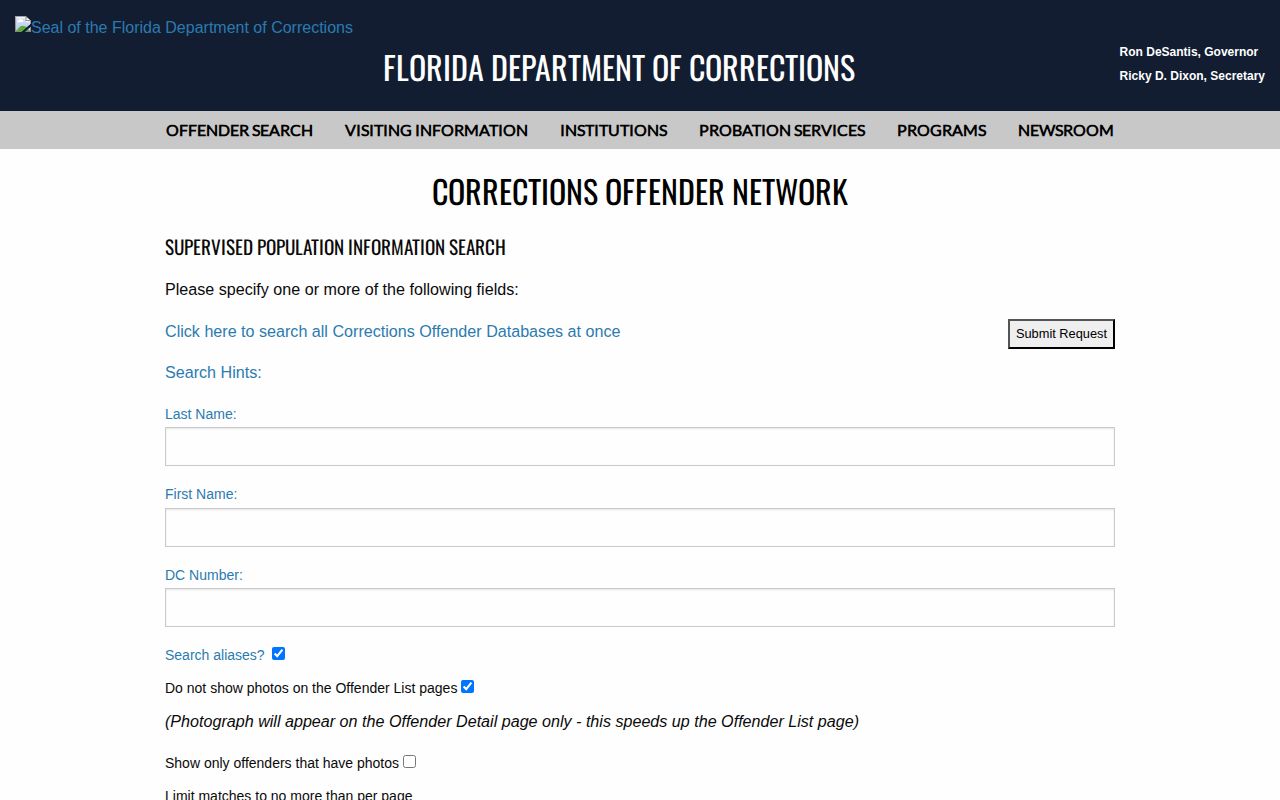
This is not a current jail roster. It addresses state community supervision. A person who served a Levy jail-only term or county supervision outside FDC may not appear.
Levy Supervision Office Records
Levy County is part of FDC Community Corrections Circuit 8, which also serves Alachua, Baker, Bradford, Gilchrist, and Union counties. The current circuit directory lists Circuit Office 085 in Alachua and nearby Office 081 in Trenton. The directory does not assign every Levy County address to Trenton, so proximity alone is not enough. The current offender detail, release instructions, or FDC confirmation should determine the reporting office.
FDC Community Corrections Circuit 8Circuit Office 085
14107 US Highway 441, Suite 300
Alachua, FL 32615
386-853-6207
Nearby Office 081
1122 East Wade Street, Suite B
Trenton, FL 32693
352-493-6760
Confirm assignment and hours before visiting
The official Circuit 8 page documents the circuit and office details.
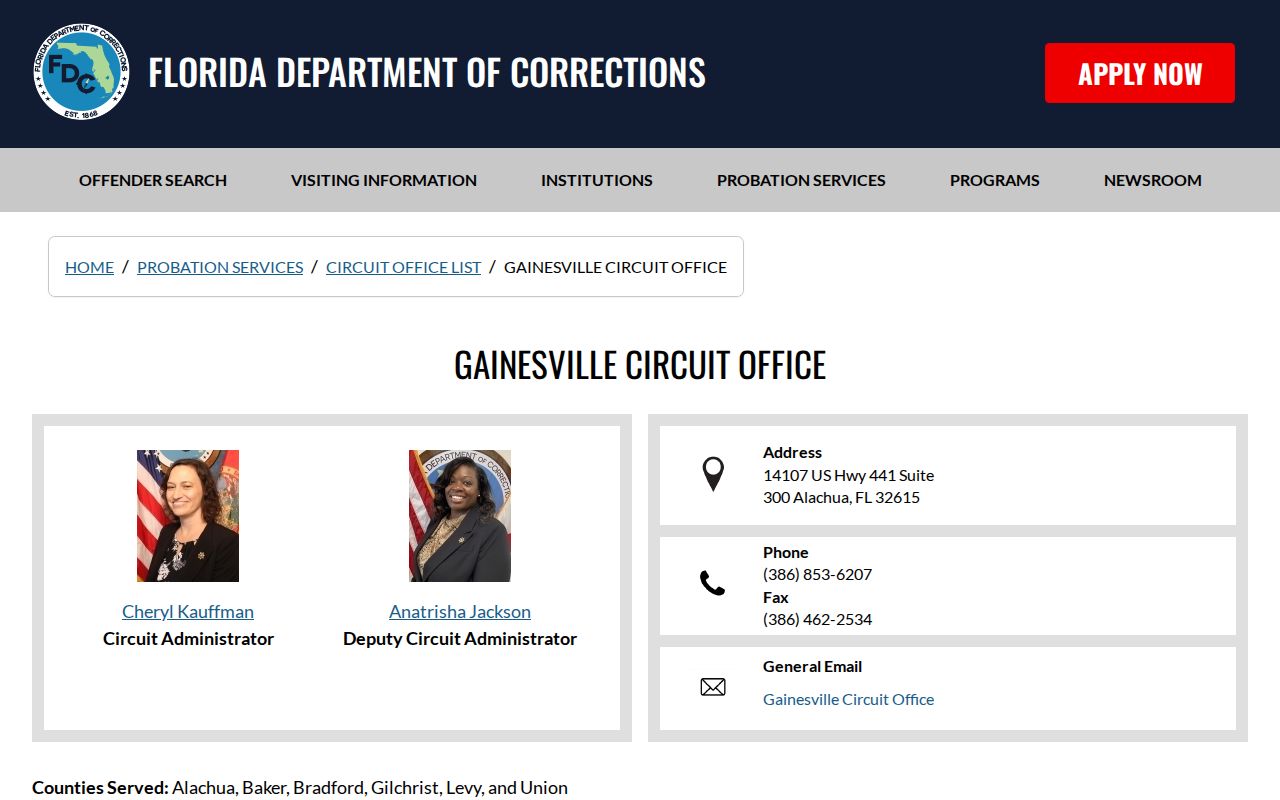
The directory is a routing tool. It is not proof that one office supervises a specific person. Call before visiting and use the reporting instructions issued for the case.
Read Levy Supervision Details
A good verification captures the type and date range, not just a broad “supervised” label. Record the supervision start, projected or actual end, circuit or office, case and offense rows, and any current status notice. If the record says absconder, use that term carefully. It means the agency reports loss of contact or noncompliance. It is not a new conviction, and it does not reveal by itself whether an arrest has occurred.
- Probation
- A court-ordered community sentence with stated conditions.
- Community control
- A restrictive form of community supervision administered by FDC.
- Parole
- Commission-authorized release for a limited eligible population, often tied to older offenses.
- Conditional release
- A statutory post-prison release term for qualifying cases.
- Absconder
- An FDC status reflecting loss of contact or reported noncompliance.
A Clerk judgment may state that probation was imposed, but it may not show the current operational office. Conversely, the FDC record can show current supervision while the court file supplies the sentence and later orders. Use each source for its role. A jail roster cannot confirm reporting instructions after release.
County probation outside FDC is another boundary. FDC states that its offender data do not include every person sentenced only to county probation. If the Levy judgment uses a county-administered term and no FDC record appears, contact the Clerk for the order and the office identified in that order. Do not force a local sentence into the state supervised-offender search. The absence of an FDC result can reflect system scope rather than the end of all court obligations.
Confirm Levy Supervision Discharge
Supervision ends through expiration, lawful early termination, discharge, revocation, or another official action shown in the governing record. A projected end date can change. Court orders, violations, tolling, new custody, Commission action, and corrections to the case may affect the practical end. “Released from prison” and “discharged from supervision” are separate events and may occur years apart.
First, check the FDC detail for a terminated status and actual end date. Then compare the judgment, later court order, or FCOR order when one applies. If the public record conflicts with release papers, contact FDC and provide the DC number, case, disputed field, and document. A written discharge record is stronger than an assumed end based only on the passage of time.
Read each supervision episode separately when the detail lists more than one case or term. One row can end while another remains active. The latest end date is not always the whole answer because the types, circuits, and court cases may differ. Ask FDC to clarify the maintained record when overlapping rows cannot be reconciled. The goal is to confirm the status shown for each term, not to infer a complete discharge from one closed row.
For a full county-to-state sequence, the Levy County release records overview shows how the LCSO movement event, court disposition, FDC custody history, and community supervision record fit together. No single source should be forced to answer every stage.
Levy Parole Eligibility Boundary
Florida largely abolished parole for offenses committed on or after October 1, 1983, subject to older sentences and specific statutory exceptions. Many modern releases therefore involve sentence expiration with gain-time, probation, conditional release, or another mechanism rather than discretionary parole. A person should not be told to expect a parole hearing merely because prison custody is ending.
The Florida Commission on Offender Review is the decision-making body for parole and certain conditional-release programs. A scheduled Commission vote is not a grant. The actual order must be checked. FDC performs community supervision functions after a qualifying release. Keeping FCOR decisions and FDC supervision distinct prevents a hearing schedule from being mistaken for a release or discharge record.
FCOR’s public schedule and detailed case lists can show that a matter is set for consideration. They are not a decisions database. For a firm result, request the final vote sheet, parole order, conditional-release order, revocation order, or other disposition and identify the person by name and DC number. Once the order is obtained, compare it with FDC’s released-inmate and supervised-offender records. The Commission action explains the legal decision, while FDC shows the operational custody and supervision status.
Note: A supervision status usually indicates community placement, but a separate jail, prison, federal, or ICE record can still show present custody.
Levy Probation Release Scope
The FDC Probation Services overview describes statewide Community Corrections rather than a physical Levy County detention facility.
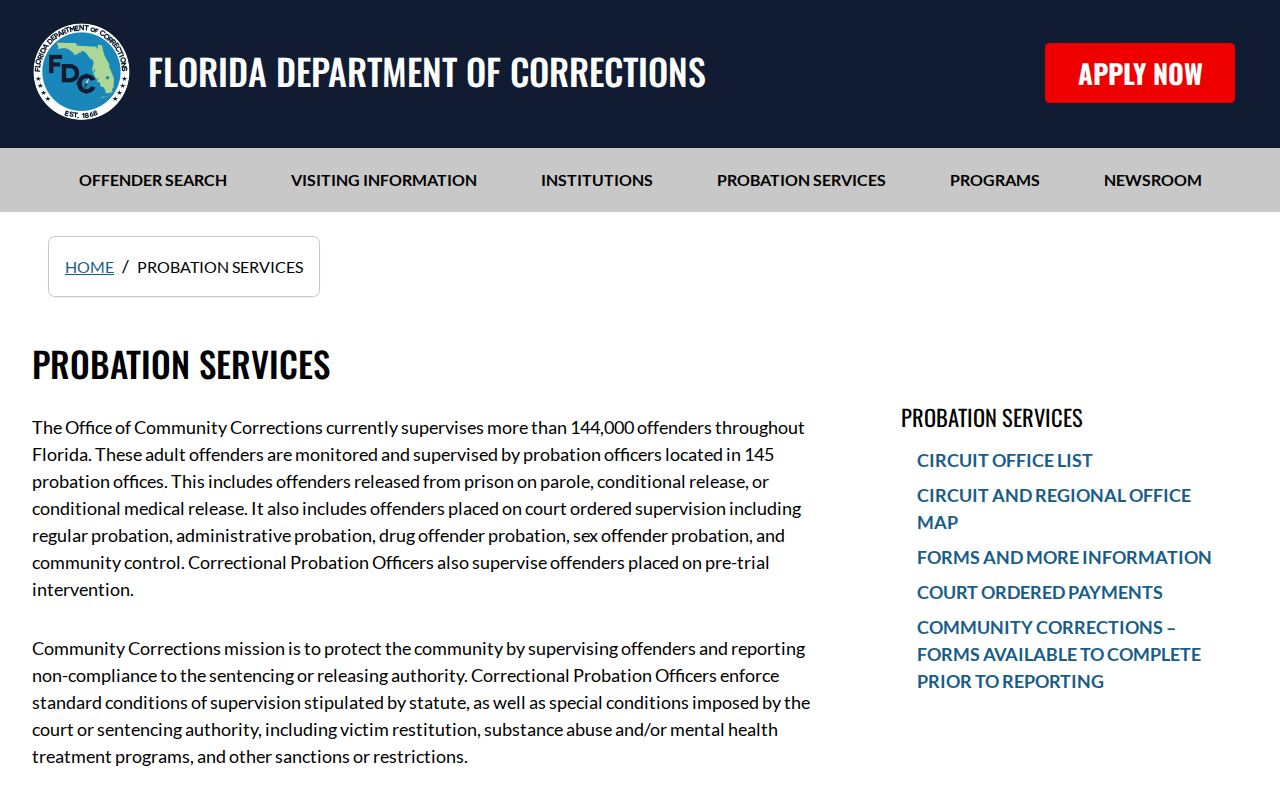
The statewide scope explains why a Levy County case can be supervised within Circuit 8 while office assignments and supervision types remain person-specific. A Community Corrections office listing is not evidence that the person is confined at an FDC building.
Community supervision can continue after a person changes residence or reporting site. An old court document may name the circuit that began the case, while a current FDC detail reflects a later office assignment. Record both dates and use the newer operational source for reporting questions. When an address or phone differs, call the number in the current official directory before acting. A directory page establishes that an office exists; it does not reveal the private schedule, conditions, or instructions for one supervised person.
For a formal supervision record, identify the person by DC number and ask FDC for the existing public record that states the supervision type, start and end dates, status, and discharge when available. A court document can be requested separately from the Levy Clerk. This division keeps the sentence order with the Clerk and the day-to-day state supervision record with FDC. If another authority takes custody during the term, that receiving system controls the current physical location while FDC continues to describe its own supervision status.