
Detention Bureau Release Paths
The Levy County Sheriff’s Office Detention Bureau is the county jail in Bronson. It holds people on Levy bookings, including those awaiting court action and some serving local sentences. A booking can end with bond, release on recognizance, time served, sentence completion, dismissal or another court order. Those events may permit a return to the community. A booking may also close because LCSO transferred the person. The destination can be the Florida Department of Corrections, another jail, federal custody, or ICE. Temporary medical and court movements may not end custody at all.
LCSO is led by Sheriff Bobby McCallum and controls its own county booking and movement records. FDC controls a later state-prison or state-supervision record. When a qualifying state release program is involved, FCOR makes the Commission decision while FDC performs supervision functions. These roles should remain separate in a custody timeline.
The final release date in the county interface marks the end of the displayed booking. It does not publish the reason or destination in the interface reviewed for this project. That distinction matters. Ask one precise question when calling: did LCSO release this person to the community, or transfer the person to another agency, and on what date? A movement or release event with an event code and destination answers far more than a missing roster name.
| County event | What to verify next |
|---|---|
| Bond, recognizance, time served | Confirm no other hold took control and compare the court docket. |
| Transfer to FDC | Search the statewide FDC offender record after intake processing. |
| Federal or ICE handoff | Use the BOP or ICE system that received custody. |
| Other-agency transfer | Request the destination and contact that receiving agency. |
Search Detention Bureau Releases
The official Levy County JailTracker has three search types: Current Only, All, and Released. Start with Current Only. A match means the LCSO booking shown remains active. If no current match appears, select Released. That mode provides 7-day and 30-day choices. All can broaden a name query, though LCSO publishes no promise that it is a permanent archive.
- Search the exact name in Current Only and record the booking identifier when a match appears.
- Change the type to Released and review both the 7-day and 30-day windows.
- Match by full name, booking date, birth information, photo, or identifier rather than name alone.
- Write down the final release date, then call or request the event type, timestamp, destination, and hold information.
- If transfer language appears, search the named receiving system before describing the event as community release.
For a broader named-person process, the Levy County released inmate search explains how to compare county, state, court, federal, and notification records. Use that path when the person is absent from both recent Levy County release windows.
Detention Bureau Release Records
The sheriff is custodian of the underlying booking and movement record. Submit a focused request through the LCSO NextRequest portal. Identify the full name, known date of birth, approximate booking period, and booking or jacket number if already public. Ask for the booking sheet, release or movement event, final release date and time, the code description, destination or receiving agency, public hold information, and the booking photograph if needed. Request an electronic copy and state a cost-notification ceiling.
LCSO’s public-record instructions say a requester can describe the information even without knowing the formal record name. They also caution against placing sensitive personal information in a public request. A narrow date and one booking reduce retrieval work. If a cryptic code is returned, ask for the releasable code legend. If a field is withheld, the custodian can identify the exemption that applies.
- Release event
- The recorded act that ends or changes the county custody episode.
- Transfer
- A handoff to another authority, not necessarily release to the community.
- Detainer
- A request or legal basis for another authority to assume or continue custody.
- Recognizance
- Court-authorized release without posting the full monetary bond, subject to conditions.
Florida public-record law allows inspection and copying subject to exemptions and reasonable retrieval or redaction time. No fixed LCSO turnaround or universal booking-photo fee was verified. Ask for a current estimate instead of assuming one.
A useful response should separate the booking date from the final movement date. It should also identify the event code, any destination that the maintained system records, and the public portion of a hold. If the portal response supplies only a booking sheet, follow up for the movement or release event by name. The two records serve different purposes. The booking sheet describes entry into custody and the initial charges. The movement event shows how LCSO custody changed or ended. Requesting both prevents an arrest record from being mistaken for proof of release.
Detention Bureau Record Contact
For a same-day status question, call the detention line. For a documented release, use the written request route. Staff may confirm whether the person remains in LCSO custody by phone, but the movement record is the durable source for the date, event type, and destination. The jail and Sheriff’s Office share the listed Bronson address.
Levy County Sheriff’s Office Detention Bureau9150 NE 80th Avenue
Bronson, FL 32621
Detention Bureau: 352-486-5121
Administration and records routing: 352-486-5111
Mail: PO Drawer 1719, Bronson, FL 32621
Public counter hours: confirm before visiting
The official Detention Bureau page identifies the facility and county contact. Its published maximum capacity is 304. Capacity is a design limit, not a live count, and should never be read as the number currently held or released.
The official facility view gives useful context. LCSO’s detention page is the source for the image below.
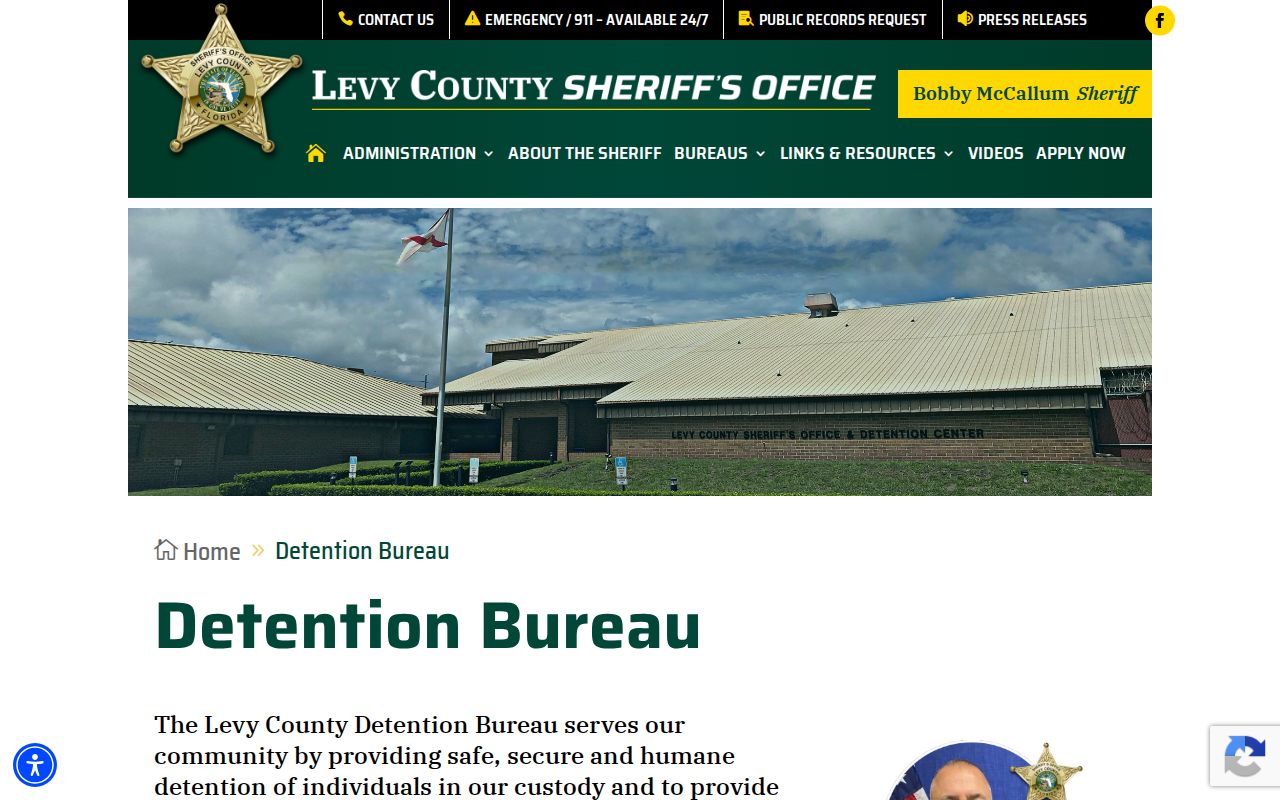
The page confirms which county agency operates the jail, while JailTracker and the records unit supply the actual custody and release evidence.
Corroborate Levy Release Records
A sheriff movement event proves what happened to physical county custody. The Levy Clerk file explains the legal action tied to the case. Read the docket for a bond order, release order, dismissal, plea, judgment, sentence, jail credit, commitment to FDC, or later warrant. Multiple cases and holds can keep someone confined after one court orders release, while a criminal case can remain open long after a bond release.
The Clerk’s electronic-access material warns that web data are informational and not certified. Its felony page also says criminal records are not online, so do not promise a complete instant search. Contact the Criminal Department for a filed order, judgment, sentence, dismissal, or certified docket record. Pair that document with the LCSO movement event. If the two sources conflict, compare timestamps and ask the custodian to explain the sequence.
A court order and a physical release can have different times. Processing, a second case, or another agency hold may lawfully delay the person’s departure after one order is entered. For that reason, the court file answers what the judge directed, while the LCSO event answers when county custody actually changed. Neither record should be silently substituted for the other.
Note: A booking photo links a person to a booking, but it does not prove the charge or show present custody.
After a Detention Bureau Release
Levy has a distinctive post-release digital-property route. The LCSO jail visitation and mail page says a former inmate may use the inmate number and password at Smart Jail Mail to download photos, messages, and scanned postal mail processed during confinement at no charge. The former user cannot reply or access request, grievance, or medical forms through that post-release login.
This account is private personal content. It is not a public inmate search, a release record, or a way for another person to obtain the government booking photo. A public booking photograph must be requested from LCSO for the identified booking. Keeping the two channels separate protects privacy and prevents a personal mail account from being mistaken for a government record portal.
Historical Levy ICE Release Handoffs
A 2019 Levy Sheriff and ICE Warrant Service Officer agreement documents a past local handoff process. Under that agreement, a scheduled criminal release could become an ICE custody transfer, with continued physical presence at LCSO for no more than 48 hours absent a reimbursable agreement. This source is historical. It does not prove that LCSO currently participates under the same terms.
If a present record says ICE detainer, transfer, or release to ICE, request the actual county movement event and verify the current status through ICE. The LCSO booking may be closed even while detention continues elsewhere. Current agency confirmation controls, not the old agreement.
Closed Levy Release Facility History
Levy Forestry Camp was once an FDC and forestry work camp in Bronson. It closed in 2012. Some old facility lists and infrastructure records may still display its name, which can create a false trail for a person looking for a current Levy County release. It is not the Detention Bureau and is not an active release locator.
Use current FDC statewide records for a state prisoner and the Bronson county jail sources for an LCSO booking. A historical facility name should only help interpret an old record. It should never be used as a present address, custody source, or proof of where someone was released.