
Levy Release Dates Are Projections
A future date in an offender record is an administrative calculation. It is not an unconditional promise that the person will walk out on that day. FDC’s active-inmate detail uses the exact public label Current Release Date. Florida law calls the calculation beneath it a tentative release date. The value can move after gain-time awards or forfeitures, sentence review, corrected credit, a new court order, or another legal event.
A pretrial Levy County detainee is different. Before conviction and sentence, release usually turns on bond, a court order, dismissal, or transfer. There may be no fixed term from which a projected date can be calculated. A county-jail-only sentence can have a calculable end, but FDC’s formula does not govern that local sentence merely because both facilities are in Florida.
- Current Release Date
- FDC’s public label for its present active-inmate calculation.
- Tentative release date
- The statutory FDC date after sentence credits and gain-time changes are applied.
- Maximum expiration
- The end of the imposed sentence or combined sentences after lawful sentence credit.
- Detainer
- A request or hold from another authority that may prevent a community release.
Find a Levy Projected Release
Start with the agency that holds the person. Sheriff Bobby McCallum’s LCSO JailTracker answers current county custody and recent release events, but it does not publish a projected-date calculator. A Levy County court judgment can state the sentence and jail credit. For a person committed to state prison, use the statewide FDC Offender Information Search. The six-character DC number is the strongest search key, though first and last name can also be used.
Match more than the name. Check the DC number, age or birth details, aliases, offense county, sentence rows, and current location. Open the active-inmate detail and reproduce the date label as displayed. If it says “TO BE SET,” review remains pending. A person sentenced in Levy County may be sent through an FDC reception center and later placed at an institution elsewhere in Florida, so the search is statewide rather than limited to Levy.
- Decide whether the person is pretrial, serving a Levy jail sentence, or serving an FDC prison sentence.
- For FDC custody, search by DC number or name and verify the full public identity and Levy case rows.
- Read the exact Current Release Date field beside the custody, location, sentence, and detainer information.
- For county custody, obtain the judgment, sentence, and credited jail time from the Levy Clerk, then ask LCSO for its calculation.
- If the sources conflict, request the underlying release-date computation instead of calculating a replacement date.
The official FDC example record is the source for the captured Current Release Date interface.
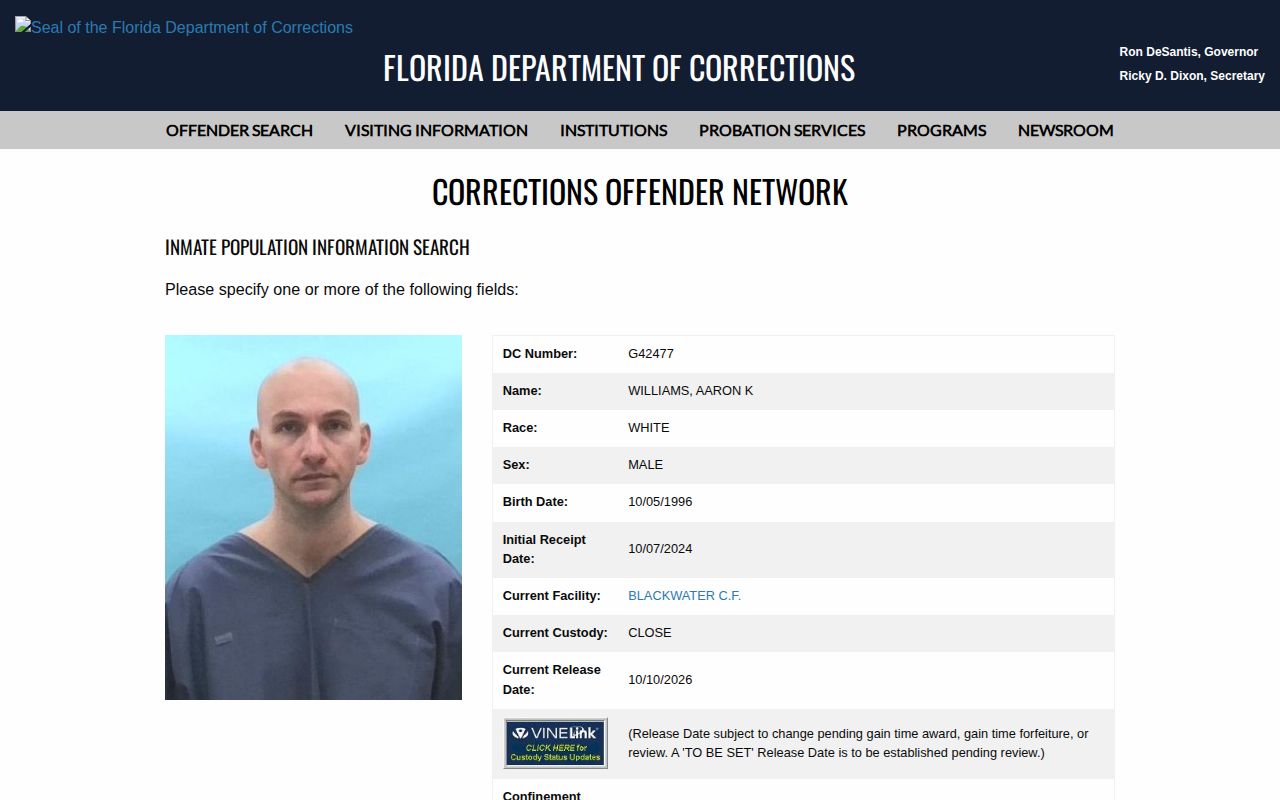
The screenshot shows why the field must be read with FDC’s warning about pending gain-time, forfeiture, and review.
Florida Calculates Levy Prison Release
Section 944.275 directs FDC to establish the maximum sentence expiration date from the imposed sentence or combined sentences, less lawful credit such as jail time awarded by the court. FDC then establishes the tentative release date through gain-time granted or forfeited. In plain terms, the maximum expiration date minus credited gain-time produces the current tentative date, subject to statutory floors and other sentence rules.
This model contains two different credits. Court-awarded jail credit accounts for qualifying time already served before the prison sentence. Incentive gain-time is administered by FDC under the statute. One cannot be swapped for the other. The sentencing judgment supplies jail credit, and FDC applies the sentence and gain-time rules to the state-prison computation. Errors in either input should be resolved from the source record.
A past Release Date on a released FDC record is stronger historical evidence than a future estimate. Still, it may mark the end of prison custody rather than the end of all state supervision. Multiple sentences and post-prison supervision can create more than one date with legal meaning.
Note: Custody, sentence, release, and supervision fields should be read together rather than reduced to one date displayed in isolation.
Levy Release Gain-Time Limits
Florida Statutes section 944.275 has date-specific rules. Basic gain-time of ten days per sentence month is limited to offenses committed from July 1, 1978 through December 31, 1993. For offenses on or after October 1, 1995, incentive gain-time may be awarded at up to ten days per month. “Up to” is crucial. The award is not automatic.
For offenses on or after October 1, 1995, gain-time cannot cause release before 85 percent of the imposed sentence has been served. Physical jail credit counts toward that floor. Section 921.002 states the same Criminal Punishment Code principle, subject to credit for time served. The 85-percent rule is a minimum service requirement, not a promise of release exactly at 85 percent.
Mandatory minimums, excluded offense categories, disciplinary forfeiture, sentence structure, and later legal changes can require more time. Life sentences do not gain an ordinary calculable expiration through incentive gain-time. Older offense dates may fall under different versions of the law, so a current statute summary cannot replace the rules that govern the actual sentence.
The official Florida gain-time statute is shown in the successful project capture.
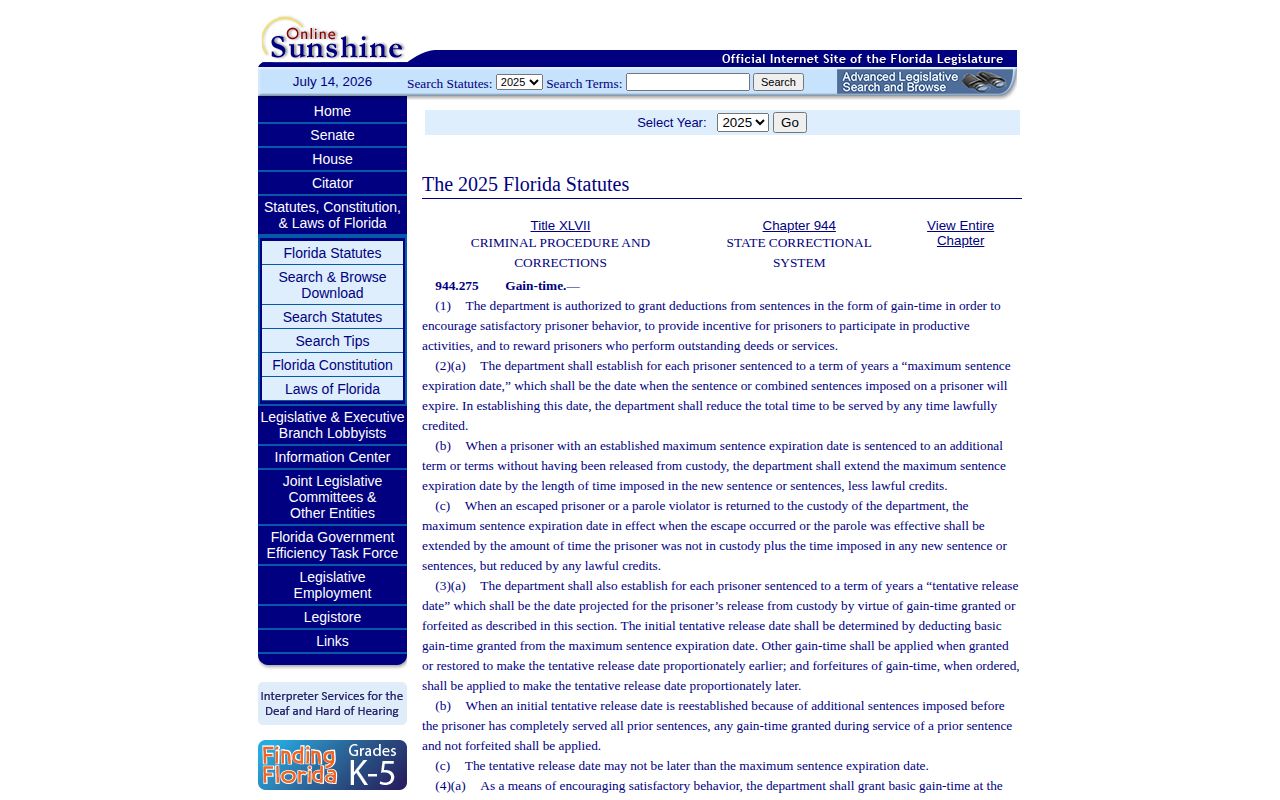
The statute supports a date calculation, but only FDC can apply the complete sentence history and current administrative record.
Why Levy Release Dates Change
A release date can move earlier or later. Section 944.28 permits gain-time forfeiture after escape, specified release revocations, institutional misconduct, and rule violations, and it provides a restoration process. FDC may also correct jail credit or complete an administrative review. Courts can amend a sentence, and an appeal can change the controlling order.
Some events do not change the arithmetic date but change what happens at the gate. A detainer may shift custody to another county, federal authorities, or immigration authorities. A new sentence can overlap or follow the current term. Parole or another Commission release mechanism can introduce a different decision date. The public date must therefore be checked against holds and the actual release authority.
| Change | Likely effect | Best check |
|---|---|---|
| Gain-time award or restoration | May move tentative date earlier | FDC computation |
| Gain-time forfeiture | May move date later | FDC disciplinary and computation record |
| Corrected jail credit | Changes sentence calculation | Court order and FDC record |
| New or amended sentence | Can change maximum expiration | Certified judgment |
| Detainer or transfer hold | May prevent community release | Custody and receiving-agency records |
| Administrative review | Date may remain pending | Current FDC detail |
Levy Jail Release Calculations Differ
A person serving only a Levy County jail sentence is outside the FDC prison-date formula. FDC expressly says its offender search does not include county jail and county probation populations outside state administration. Use the actual judgment and sentence, including the court-awarded custody credit, then request the final calculation or release event from the LCSO Detention Bureau.
The Levy Clerk felony office can supply the filed judgment, sentence, or later order. The criminal file is not promised as a complete instant online search, so contact the Criminal Department when the web access path does not show the needed record. LCSO confirms the physical custody event. Those two sources answer different questions: the court states the legal term, and the jail records how that term affected actual custody.
Section 951.04 applies only in a related, narrow setting. It provides transportation or equivalent money back to the place from which sentenced when a county prisoner is discharged after serving the sentence, or on pardon or parole. It does not calculate the Levy release date and should not be extended to bond or dismissal. Its relevance begins only after the qualifying county discharge.
Note: Do not apply the state-prison 85-percent floor to a Levy county-jail-only term without authority in the actual local sentence record.
Confirm Levy Release Date History
FDC updates individual release information nightly. Its OBIS bulk Inmate-release-root table covers state inmates released since October 1, 1997, with related alias, offense, detainer, and incarceration-history tables. Bulk data are generally updated monthly. Sealed or expunged records are removed. That historical range applies to state-prison data, not every person released from the Levy jail.
When a date looks wrong, save the public detail URL, the DC number, and the exact field. Compare the result with the certified judgment, sentence, or release paper. Then request FDC’s release-date computation through its public-record route. Do not treat a public locator as proof that the court is wrong. The underlying commitment and release documents control.
Post-prison supervision creates another date distinction. A person may leave an FDC institution on the displayed prison-release date and then begin probation, conditional release, or another form of state supervision. That person is no longer in prison, but the state relationship continues. Read the current status, supervision type, office, and start or end dates before calling the displayed date a full discharge from FDC authority.
Parole has its own decision record. Florida parole eligibility is narrow, and an FCOR hearing schedule is not a release order. A presumptive parole release date is a tentative guideline date. An effective parole release date is set later after the Commission reviews conduct and the release plan. For an eligible Levy case, compare the final Commission order with the FDC active, released, and supervised records.
A records request should be precise. Identify the person by DC number, name the disputed Current Release Date field, and ask for the release certificate or date computation tied to the sentence at issue. Attach or cite the relevant judgment when lawful and useful. FDC can apply its own sentence data; the Levy Clerk can certify what the court ordered. Neither the public nor the jail should be asked to invent a new calculation outside its records.
The Levy VINELink check can add a custody-change alert while a person remains in a participating agency’s feed. For historical confirmation after release, use the agency record instead. The Levy County released inmate record path separates a county release, state discharge, and transfer so the date is tied to the right event.