
Florida Corrections Release Path
A person sentenced from Levy County may leave the Sheriff’s Detention Bureau for an FDC reception center. FDC then assesses custody level, health and program needs, bed space, and other factors before assigning an institution. The county of conviction does not control the final placement. The FDC institutions overview describes this statewide reception and placement process. There is no active state prison in Levy County verified by the current facility sweep, and no separate Levy state-prison release roster.
The Levy County Sheriff’s Office, led by Sheriff Bobby McCallum, documents the county transfer that starts this sequence. FDC records the state intake, placement, prison release, and state supervision. FCOR enters the picture only for parole and specified Commission-administered release programs. A Commission action and an FDC custody update are related records, not interchangeable ones.
When prison custody ends, the public FDC offender detail is the first historical route. A released record can show a release date, custody status, aliases, sentence history, detainers, photograph, and incarceration history. If community supervision follows, the person is out of prison but still subject to a lawful supervision term. A transfer from the county jail into FDC is not a release to the community, just as an FDC discharge does not by itself resolve a separate federal, county, or immigration hold.
| Record state | Meaning | Next check |
|---|---|---|
| Active inmate | FDC prison custody remains active. | Read the assigned institution and current release date. |
| Released | The displayed FDC custody episode ended. | Read the past date, history, and detainer rows. |
| Supervised | The person is generally in the community under FDC conditions. | Confirm supervision type and assigned office. |
| Absconder | FDC reports lost contact or noncompliance. | Do not infer arrest; verify current agency status. |
Search Florida Corrections Releases
Open the FDC Released Inmate Search. A six-character DC number is the strongest input. When it is not known, search by first and last name. The search supports prefix matching and can include aliases. FDC says released-inmate information includes people already released and those scheduled for release, while release date and location data update nightly. A result therefore needs careful date reading.
- Enter the DC number, or search the most complete known name and include aliases when appropriate.
- Open the likely detail and compare name, DC number, age or birth date, sex, race, and offense county.
- Read Release Date with Custody, incarceration history, Date Out-Custody, sentence rows, and detainers.
- Decide whether the date is past or future and whether the record shows state supervision after prison.
- Request the underlying FDC release record when the public fields conflict with a judgment or release paper.
The public released-offender example illustrates the type of detail a user must read together.
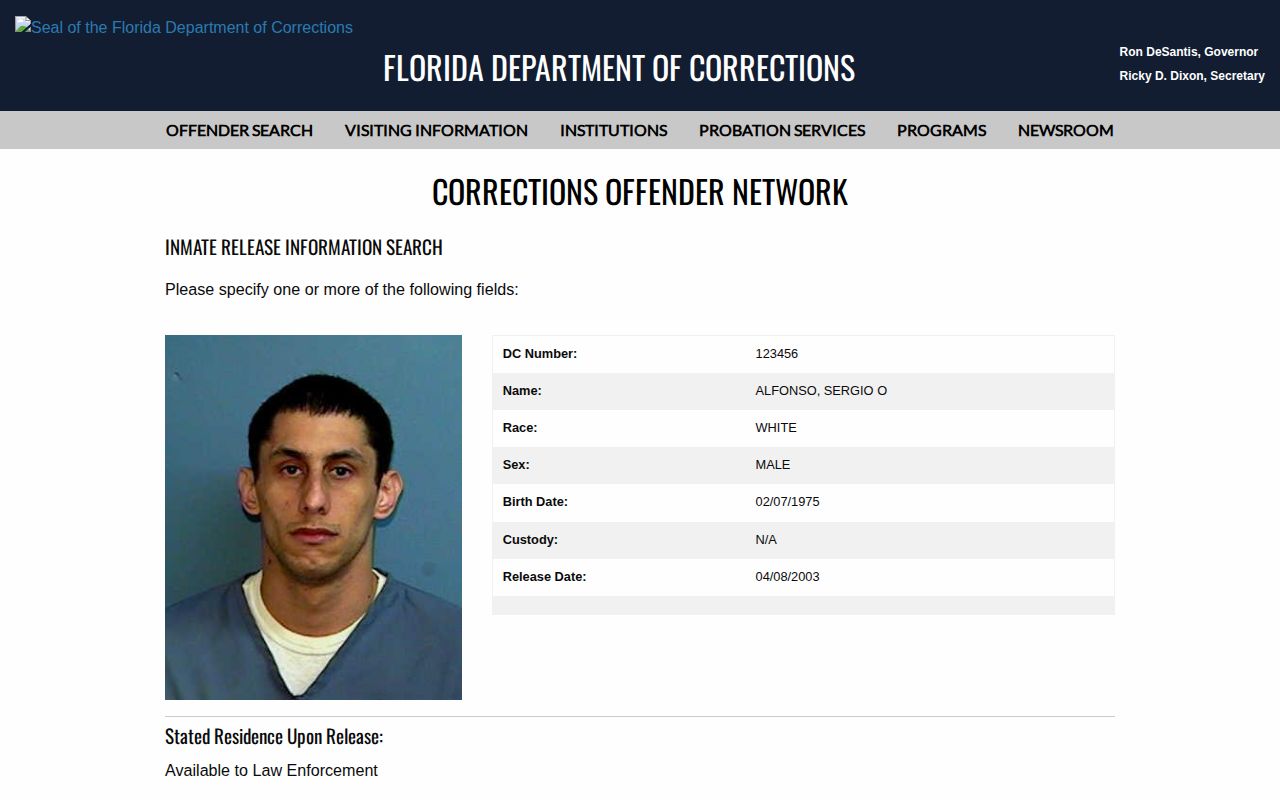
The example shows why one field is not enough. Custody, release date, history, and any detainer should agree before the result is described as a completed state-prison release.
Florida Release Record Fields
FDC’s released-inmate search covers felony offenders sentenced to state prison or state supervision. It does not cover a person who served only a Levy County jail sentence or county supervision outside FDC. Repeating an FDC name search will not create a record for a jail-only case. For that person, use LCSO’s release event and the Levy Clerk file.
| Field | How to read it |
|---|---|
| DC Number | The six-character FDC identifier used to separate similar names. |
| Custody | Current FDC custody classification; N/A alone does not prove release. |
| Release Date | A past or scheduled date that must be read with status and history. |
| Date Out-Custody | The end of a listed incarceration episode. |
| Detainer | Possible continued custody or claim by another authority. |
| Supervision | Community status, type, office, and term when FDC supervises the person. |
Names can produce false matches. Compare identifiers and offense county rather than assuming that every person with a Levy connection was incarcerated by FDC. A county booking can close before FDC intake appears online, so a short data-transfer gap is possible after sentencing.
Florida Current Release Dates
For an active inmate, FDC uses the public label Current Release Date. The statutory calculation beneath it is the tentative release date. It can change due to gain-time awards or forfeitures, corrected jail credit, court action, sentence structure, mandatory minimums, detainers, and administrative review. “TO BE SET” means the review is not complete. A future date is not an unconditional promise of release.
FDC’s active-inmate detail example displays the current-release-date field and its warning.
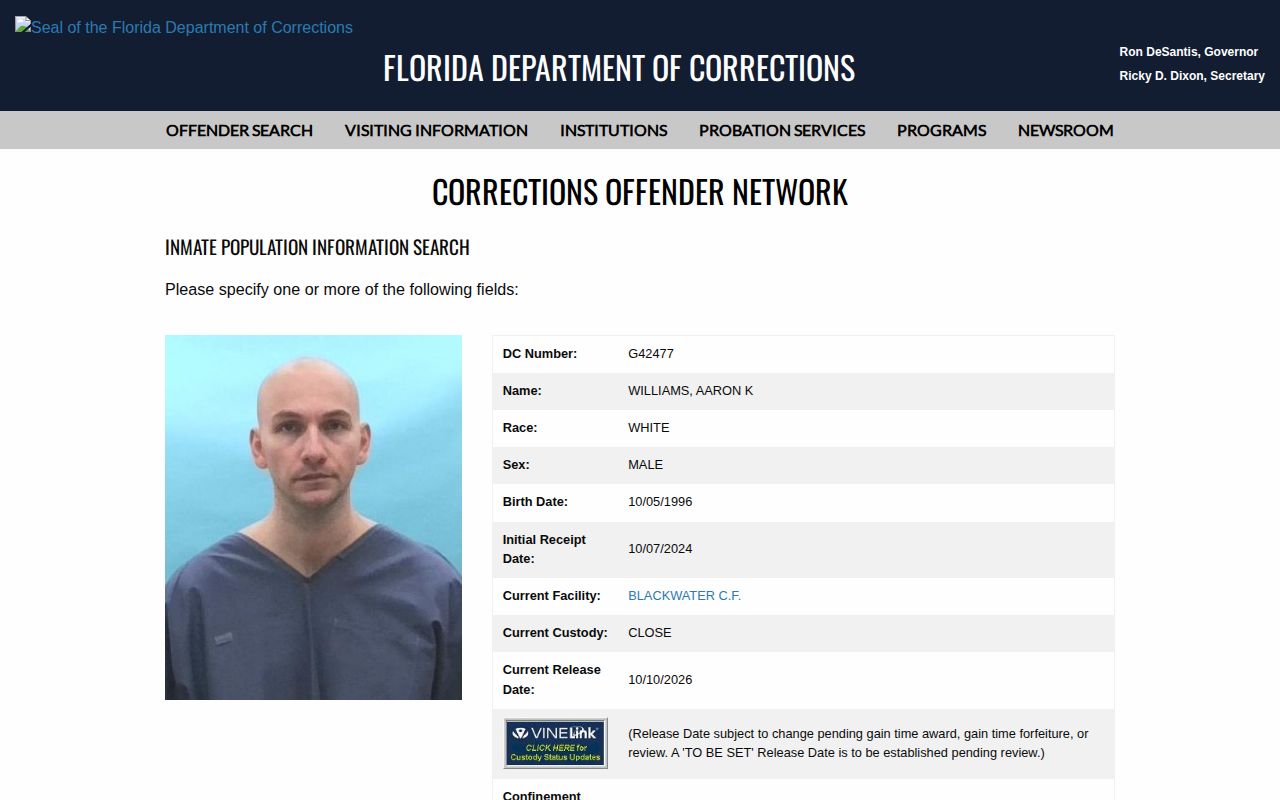
The warning connects the displayed date to an administrative calculation, not a guaranteed exit. A past date on a released record is stronger historical evidence, but multiple sentences and post-prison supervision can produce more than one meaningful end date.
Florida Statutes § 944.275 governs gain-time. For offenses committed on or after October 1, 1995, gain-time cannot make a prisoner serve less than 85 percent of the imposed term, with qualifying jail credit counting toward that floor. The rule is a minimum service floor, not a promise of release at exactly 85 percent. County-jail-only sentences use their actual judgment and local release calculation, not the FDC formula.
Request Florida Discharge Records
The public offender detail is a locator, while the underlying commitment and release documents control. When a date appears wrong, preserve the record URL and exact disputed field. Compare it with the certified judgment, sentence, jail-credit entry, or release paper. Then submit a focused request through the FDC public-records route and identify the DC number, sentence or case, and the exact record sought.
Useful records include a release certificate, release-date computation, incarceration history, or another specifically named public record. Ask for electronic delivery. FDC can lawfully withhold protected information, and a public search error should not be framed as proof that a court is wrong. If supervision followed, request or verify the separate supervision record rather than treating prison departure as the end of every FDC relationship.
Florida Department of CorrectionsStatewide institutions and Community Corrections
Released-inmate access: FDC Offender Information Search
Formal records: FDC public-records portal
No physical FDC institution verified in Levy County
Confirm current office contact and hours in the official directory
FDC also documents a historical OBIS released-data collection. Its Inmate-release-root bulk table covers state inmates released since October 1, 1997, with related alias, offense, detainer, and incarceration-history tables. Individual release information updates nightly, while bulk data are generally monthly. Sealed or expunged records are removed from the public data. This state-prison history can help explain an older FDC result, but it does not contain every Levy County jail-only release and should never replace an LCSO movement record.
- Discharge
- The end of the identified custody or supervision obligation.
- Gain-time
- Credit FDC may award under law that can move a tentative date earlier.
- Jail credit
- Time credited by the sentencing court for qualifying pre-sentence confinement.
- Detainer
- A claim that may shift custody to another authority when FDC custody ends.
Supervision After Florida Release
FDC Community Corrections supervises probation, community control, and several post-prison release groups. FCOR makes decisions for parole and certain conditional-release programs. These are distinct agencies and roles. “Parole” should not be used as a generic name for all Florida supervision, particularly because parole eligibility is largely limited to older offenses and statutory exceptions.
Use the FDC supervised-offender search when the released detail suggests supervision. Record the exact type, present status, office, start and end dates, and case rows. A supervised status generally means the person is in the community. An absconder label means reported loss of contact or noncompliance; it does not prove the person has been arrested. The reporting instructions on official release paperwork control while a public data issue is being corrected.
Levy is in FDC Community Corrections Circuit 8. Office assignments can change, so confirm the assigned location in the current offender record or circuit directory. The Sheriff cannot supply current FDC reporting instructions.
When FCOR administers the release program, a hearing schedule or agenda is only a pending action. Obtain the final Commission order before stating that parole or conditional release was granted, modified, or revoked. Then compare the order with FDC’s actual release and supervision records. This keeps the decision date, prison-release date, and supervision start from being merged into one event.
Levy State Facility History
Levy Forestry Camp was a real FDC and forestry work camp in Bronson, but it closed in 2012. Old state documents and infrastructure lists can keep the name visible long after operations end. It is historical context only. It is not an active institution, a current state release office, or the place to search for a person sentenced from Levy County.
Current statewide sources must control. Search the FDC offender record for present placement or release history, and request records from FDC when more proof is needed. The closed camp should only help interpret an old incarceration record that actually names it. No current release, visit, mail, or reporting instructions should be attached to that former site.
Note: A state institution assignment can change during a sentence, but the DC number remains the strongest public search key.